
Interventional Pain Management: The Precision Path to Lasting Relief

What if the most effective way to reclaim your mobility isn't found on an operating table, but through the lens of a high-definition imaging screen? For many people living with chronic conditions, the daily reality is a frustrating cycle of limited movement and the growing shadow of medication side effects. You might feel that your world is shrinking, leaving you to wonder if major surgery is the only remaining path to relief. It's a common fear, but modern medicine has evolved to offer a more targeted, less invasive alternative.
This is the core of interventional pain management. We agree that you deserve more than just a way to mask your symptoms; you deserve a clear, logical diagnosis that addresses the root cause of your discomfort. By utilizing sophisticated, image-guided technology, these procedures allow for incredible precision, delivering relief directly to the source of pain. You'll discover how these advanced treatments can help you return to the activities that define your quality of life, like gardening or walking, while reducing your reliance on long-term prescriptions. In the following sections, we'll examine the specific methodologies that bridge the gap between conservative care and surgery, providing a steady path toward lasting restoration.
Key Takeaways
- Understand how interventional pain management acts as a sophisticated bridge between conservative therapies and invasive surgery to address the source of your suffering.
- Learn why image-guided technologies like fluoroscopy and ultrasound are essential for delivering treatments with pinpoint accuracy and enhanced safety.
- Compare the benefits of minimally invasive care against traditional surgery, focusing on reduced recovery times and the use of local sedation.
- Identify specific, targeted interventions for conditions such as sciatica and joint arthritis that prioritize long-term relief over temporary fixes.
- Discover how a personalized treatment plan can help you reclaim your independence and return to the daily activities you love.
Beyond the Surface: What is Interventional Pain Management?
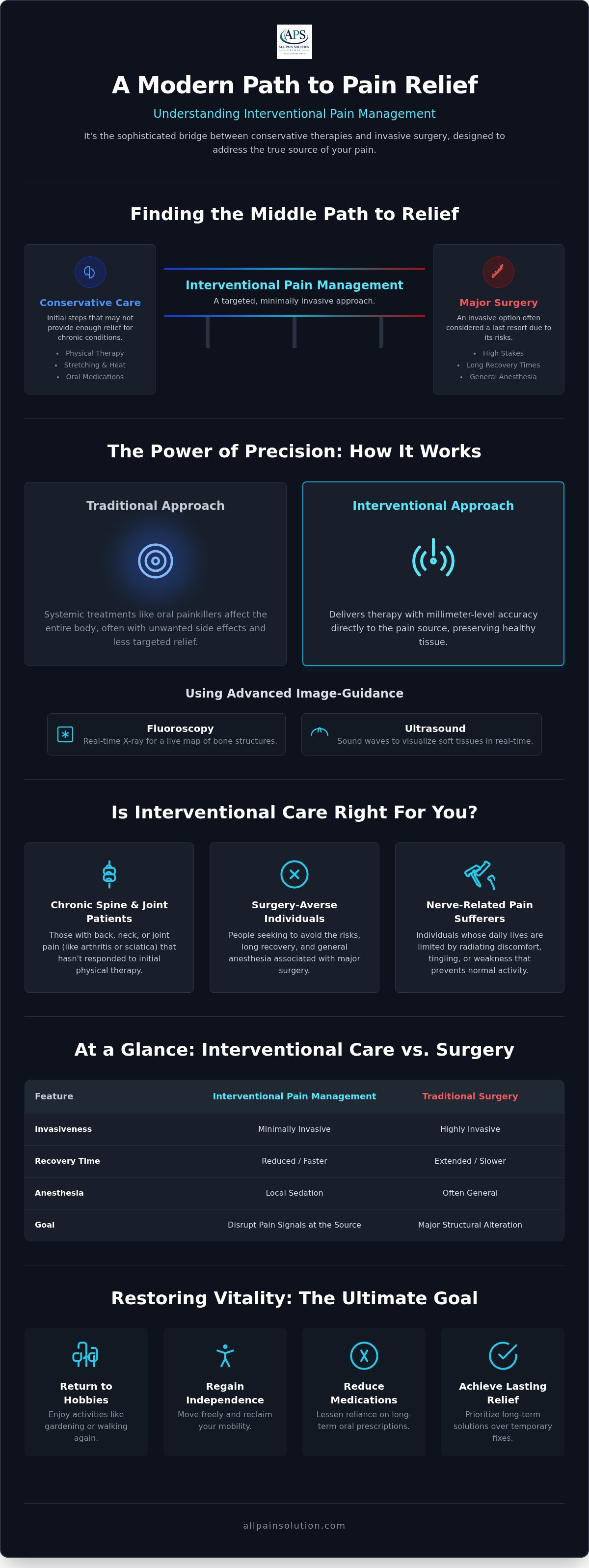
Pain is more than a symptom; it's a signal that dictates your daily boundaries. When standard physical therapy doesn't provide enough relief and the prospect of major surgery feels too extreme, you need a middle path. Interventional pain management fills this critical gap. Think of this discipline as a bridge. On one side, you have conservative options like stretching or heat; on the other, you have the permanence and high stakes of surgery. This field sits in the middle, offering a way to address complex issues that conservative care alone can't fix. It's a specialized medical discipline focused on diagnosing and treating the specific source of pain using minimally invasive techniques.
Unlike traditional approaches that might rely on systemic medications to dull your senses, this field aims to actively disrupt the pain signals at their origin. The "interventional" label is significant because it implies a direct, targeted action. We aren't just observing the pain or helping you live with it; we're actively intercepting the transmission of discomfort before it reaches your brain. It's about taking a proactive step to stop the cycle of chronic inflammation and neural over-sensitivity, transitioning from simply masking how you feel to fundamentally changing the biological environment that creates the pain.
The Core Philosophy of Targeted Relief
Precision is the foundation of recovery. In many traditional settings, treatment involves broad strokes like oral painkillers that affect your entire body. We view pain as a biological signal that we can modulate with extreme accuracy. By focusing on localized interventional pain management, we can deliver therapeutic agents or use specialized technology to reset overactive nerves. This approach ensures that we treat the source without damaging the surrounding healthy tissue. You gain the benefit of advanced science without the long recovery times associated with more invasive methods. It preserves your body's natural structure while providing the relief you need to move freely again.
Who Benefits Most from Interventional Care?
Not every patient requires the same solution, and identifying the right candidate is part of our commitment to thoroughness. This path is often the most effective choice for individuals who find their world shrinking due to persistent physical limitations. You might benefit most if you fall into these categories:
- Chronic Spine and Joint Patients: Those struggling with back, neck, or joint issues that haven't responded to initial physical therapy.
- Surgery-Averse Individuals: People seeking to avoid the risks associated with general anesthesia or long hospital stays.
- Nerve-Related Pain Sufferers: Individuals whose daily lives are limited by radiating discomfort, tingling, or weakness that prevents them from enjoying hobbies like gardening or walking.
If your life feels limited by these conditions, interventional care offers a way forward. It provides a clear, logical diagnosis based on how your body responds to targeted treatments, giving you back the independence you thought was lost. You can return to your daily routines with a grounded sense of hope and a clinical plan that actually addresses the source of your suffering.
The Power of Precision: How Image-Guided Procedures Work
Precision is the defining factor in a successful recovery journey. In traditional pain care, treatments are often broad, affecting the entire body just to reach one small, localized area. Interventional pain management flips this logic by using sophisticated technology to look inside your body in real-time. We don't just treat the general area of your back or neck; we target the specific nerve or joint causing the distress. This millimeter-level accuracy is what transforms a standard procedure into a life-changing intervention, ensuring that healthy tissue remains undisturbed while the source of your pain is addressed directly.
Fluoroscopy and Ultrasound: The Physician’s Eyes
To achieve this level of accuracy, we rely on two primary imaging modalities that act as our eyes during a procedure. Fluoroscopy is a real-time imaging tool used to guide needles with sub-millimeter accuracy. It acts as a live-action map of your spinal structures, allowing the physician to navigate around delicate bones and nerves with total confidence. While fluoroscopy visualizes the skeletal system, ultrasound provides a clear view of soft tissues, tendons, and blood vessels. By combining these tools, we ensure that the needle path is safe and the medication is delivered exactly where it will have the most impact. This visualization removes the guesswork that often leads to inconsistent results in less advanced settings.
The Step-by-Step Procedural Experience
We understand that the idea of a needle-based procedure can cause anxiety, which is why our process is designed to be as methodical and reassuring as possible. Your journey begins with a local numbing agent applied to the skin, which significantly minimizes any sensation. Unlike major surgery, these procedures typically use local or conscious sedation, allowing you to remain comfortable without the risks associated with general anesthesia. Once you are prepared, the physician uses image guidance to deliver the treatment, whether it's a precise injection of anti-inflammatory medication or the application of thermal energy to disrupt a pain signal.
Following the procedure, you'll spend a brief period in a dedicated monitoring area to ensure your comfort. Because these techniques are minimally invasive, the recovery window is remarkably short. Most patients are able to walk out of the clinic shortly after their appointment and return to light daily routines within a day or two. If you are ready to move beyond generalized care, you can speak with our specialized physician team to see how these precision tools can benefit your specific condition. This logical, technology-driven approach ensures that your path to restoration is both safe, predictable, and scientifically sound.
Navigating Your Options: Interventional Care vs. Traditional Surgery
Choosing a path toward physical recovery is a significant decision that requires a clear understanding of the trade-offs involved. For many, the word "treatment" immediately conjures images of an operating room and a long, difficult road to recovery. However, modern interventional pain management offers a sophisticated alternative that prioritizes your body's natural integrity. The most striking contrast between these two paths lies in the timeline of your restoration. While traditional surgery often demands months of intensive rehabilitation and significant time away from your responsibilities, interventional procedures typically allow you to return to your routine within days. This efficiency isn't just a matter of convenience; it's a reflection of a more targeted, less traumatic approach to healing.
Sedation levels also distinguish these methodologies. Major operations require general anesthesia, which carries systemic risks and a longer "foggy" recovery period. In contrast, interventional care utilizes local or conscious sedation. You remain comfortable and relaxed, but your body doesn't have to process the heavy burden of general anesthetic. From a financial perspective, the logic of outpatient care is equally compelling. By avoiding hospital stays and the associated inpatient fees, you can access high-level medical expertise in a more streamlined, cost-effective setting. We also need to address the myth that interventional care is a "last resort." In reality, it's often the most logical first or second step, providing a solution before the structural changes of surgery become necessary.
Understanding the Risk-Benefit Ratio
Safety is a cornerstone of our clinical philosophy. Because interventional procedures don't require major incisions, the risk of post-operative infection is significantly reduced. More importantly, these techniques focus on the preservation of spinal stability. Traditional back surgeries sometimes involve removing bone or ligaments to reach a target area, which can occasionally lead to future instability. Interventional care uses specialized needles to reach the same source without compromising the structural support of your spine. It's a medically superior starting point for those who want to solve the problem while keeping their anatomy intact.
The Impact on Your Quality of Life
The transition from limitation to restoration has profound personal implications. For our patients in Atlanta, this means returning to work, family gatherings, and hobbies like gardening much faster than a surgical path would allow. This approach also plays a vital role in medication management. By treating the source of the pain directly, we can often reduce the long-term need for opioid-based prescriptions, protecting you from potential side effects and dependency. There is also a significant psychological benefit to this path. Knowing you can achieve lasting relief without "going under the knife" provides a sense of calm and confidence that is essential for a complete recovery journey.
Targeted Solutions for Chronic Conditions: From Sciatica to Joint Pain
Chronic suffering often feels like a vague, heavy burden, but its biological origin is usually quite specific. Whether you're dealing with the sharp, radiating heat of sciatica or the grinding stiffness of facet joint arthritis, interventional pain management provides a roadmap to relief. For conditions like herniated discs, we utilize epidural steroid injections to deliver potent anti-inflammatory agents directly to the irritated nerve root. This targeted approach reduces swelling and allows the nerve to heal in a way that generalized oral medications simply cannot achieve. In the cervical spine, where neck pain can limit your ability to drive or work, we apply the same level of precision to soothe inflamed joints and nerves, helping you reclaim your range of motion.
Addressing the Nerve: Blocks and Ablations
Precision care often begins with a diagnostic nerve block. This procedure serves a dual purpose: it provides immediate, temporary relief and confirms that we've identified the exact source of your discomfort with clinical certainty. Think of it as a biological test; if the block silences the pain, we know exactly where to focus our long-term efforts. Once the source is verified, we can move toward more durable solutions like Radiofrequency Ablation (RFA). RFA uses thermal energy to interrupt pain signals for 6 to 12 months. By desensitizing the specific nerves responsible for transmitting pain, we create a long-term window of relief that allows you to engage more fully in physical therapy and daily activities. It's a methodical, scientific way to quiet the "alarm system" of your body without the need for structural surgery.
Regenerative Medicine: Supporting the Body’s Recovery
While blocks and ablations address the immediate signal of pain, regenerative medicine focuses on the underlying health of the tissue. These innovative therapies use your body's natural healing mechanisms to support joint restoration and reduce long-term degeneration. At our clinic, we often use these treatments to complement traditional interventional blocks, building a foundation for lasting vitality. By combining these methodologies, we facilitate a complete transition from a state of physical limitation to one of active restoration. This multi-layered strategy ensures that we aren't just silencing symptoms but actively fostering an environment where your joints and spine can thrive. If you're ready to target the source of your discomfort, schedule a consultation with our Douglasville specialists today to explore a personalized recovery plan.
Restoring Vitality: Your Journey at All Pain Solution Clinic
Restoration is more than just the absence of pain; it's the return of your vitality. At All Pain Solution Clinic, we approach your recovery with a sophisticated blend of clinical authority and quiet empathy. We understand that chronic conditions don't just affect your body; they impact your independence and peace of mind. Our Douglasville physician team specializes in creating personalized treatment plans that move beyond surface-level symptoms to address the biological source of your suffering. By integrating interventional pain management with on-site physical therapy, we provide a cohesive environment where you can transition from limitation to a state of full restoration.
This integrated approach addresses a common gap in modern healthcare. Many facilities offer procedures without the necessary follow-up support, leaving patients to navigate their recovery alone. We ensure that your image-guided treatment is followed by professional physical therapy, allowing your body to rebuild strength and mobility in a controlled, supportive setting. This seamless transition ensures that the relief you find during your procedure becomes a foundation for long-term health and movement.
A Compassionate Guide Through Chronic Pain
We believe that a successful journey begins with a thorough medical consultation. Our commitment starts with listening to your unique story, ensuring we capture every detail of how your condition affects your daily existence. This thoroughness allows us to build a scientifically rigorous plan tailored specifically to your needs. Our Douglasville team utilizes interventional pain management as a precise tool to restore your physical boundaries while serving the greater Atlanta community with expert, reliable care. We don't just act as a provider; we're a specialized partner invested in your long-term human outcome.
Taking the First Step Toward Restoration
Reclaiming your quality of life shouldn't be a complicated process. We've streamlined the path to care, offering an easy scheduling experience through our online calendar or a simple phone call. When preparing for your visit to our Douglasville facility, you can expect a professional, calm environment designed to build your confidence at every step. Our methodical approach ensures that you feel informed and supported from your first consultation through your final day of recovery. If you're ready to leave the cycle of pain behind and return to the activities you love, schedule your consultation at All Pain Solution Clinic today.
Your Future Without the Weight of Chronic Pain
You don't have to accept physical limitation as a permanent state. By choosing interventional pain management, you're opting for a scientifically grounded path that targets the source of your suffering with sub-millimeter precision. This methodology effectively bridges the gap between basic care and invasive surgery; it offers a way to restore your quality of life without the long recovery times or systemic risks of more aggressive options. You can return to the activities that define you, knowing your treatment is based on a clear, logical diagnosis and a commitment to your long-term vitality.
At All Pain Solution Clinic, our expert team of specialized physicians is dedicated to being your partner in this restoration. Our convenient Douglasville location offers evening hours to fit your busy schedule, ensuring that high-level care is always within reach. We provide a comprehensive environment that integrates image-guided procedures with on-site physical therapy and medication management, creating a cohesive plan tailored to your unique needs. It's time to move toward a life of renewed movement and independence. Begin your journey to restoration at All Pain Solution Clinic. We're here to help you take that first confident step toward a brighter, more active future.
Frequently Asked Questions
What exactly is interventional pain management?
Interventional pain management is a specialized medical discipline focused on diagnosing and treating the biological source of chronic pain using minimally invasive techniques. Unlike traditional approaches that may rely on systemic medications, we use image-guided procedures to deliver relief directly to the affected nerve or joint. This targeted methodology allows us to interrupt pain signals effectively while preserving your surrounding healthy tissue, serving as a critical bridge between conservative therapy and surgery.
How long do the results of interventional pain procedures last?
The duration of relief depends on the specific procedure and your body’s unique response to treatment. A diagnostic nerve block may provide temporary relief to confirm a pain source, while more advanced treatments like radiofrequency ablation typically offer results lasting between 6 to 12 months. Our team in Douglasville focuses on creating a window of comfort that allows you to engage in physical therapy, which helps build a foundation for more permanent restoration.
Are interventional pain procedures covered by insurance?
Most major insurance plans, including Medicare, provide coverage for these specialized procedures because they’re recognized as medically necessary treatments. However, specific requirements like prior authorization or a history of conservative care can vary by provider. Our staff assists patients throughout the Atlanta area in navigating these administrative details. We recommend verifying your specific benefits before your consultation to ensure a clear understanding of your professional fee responsibilities during your recovery.
Is interventional pain management safer than surgery?
These procedures generally carry a lower risk profile because they don't require major incisions or general anesthesia. By utilizing local or conscious sedation, we avoid the systemic complications often associated with being put under for a long operation. Because our physicians use real-time imaging to visualize the needle path, we significantly reduce the risk of infection and tissue damage. It’s a scientifically rigorous path that prioritizes your safety and stability.
Will I be awake during my interventional pain procedure?
You'll typically remain awake and relaxed during your treatment. Most procedures utilize local anesthetics to numb the injection site, and some patients may receive light conscious sedation to ensure total comfort. This approach is beneficial because it allows you to communicate with your physician during the process while avoiding the heavy recovery period associated with general anesthesia. It’s a methodical, controlled experience designed to keep you at ease from start to finish.
How soon can I return to work after a nerve block or injection?
Most patients return to their normal daily routines within 24 to 48 hours. Because these techniques are minimally invasive, your body doesn't require the extensive healing time mandated by traditional surgical paths. While we generally recommend taking it easy on the day of your procedure, you can usually resume light activities and work quickly. This rapid transition is a core benefit for our active patients in Douglasville and the greater Atlanta area.
Do I need a referral to see a pain management specialist in Douglasville?
While some insurance plans require a formal referral from a primary care doctor, many patients can schedule their initial consultation directly with our team. We offer a streamlined process through our online calendar to make accessing care as simple as possible. If you’re unsure about your plan's requirements, our office can help clarify whether you need a referral to begin your journey toward restoration at our Douglasville clinic location.
What is the difference between a pain clinic and interventional pain management?
A general pain clinic may focus heavily on medication management or lifestyle advice, but interventional pain management is defined by the use of precise, procedural techniques. We don't just manage your symptoms; we actively intervene at the source using advanced imaging like fluoroscopy. This specialized focus allows us to offer targeted solutions like nerve blocks and regenerative medicine, providing a more logical and technology-driven approach to your physical restoration and health.
Frequently Asked Questions
Not every patient requires the same solution, and identifying the right candidate is part of our commitment to thoroughness. This path is often the most effective choice for individuals who find their world shrinking due to persistent physical limitations. You might benefit most if you fall into these categories: If your life feels limited by these conditions, interventional care offers a way forward. It provides a clear, logical diagnosis based on how your body responds to targeted treatments, giving you back the independence you thought was lost. You can return to your daily routines with a grounded sense of hope and a clinical plan that actually addresses the source of your suffering. Precision is the defining factor in a successful recovery journey. In traditional pain care, treatments are often broad, affecting the entire body just to reach one small, localized area. Interventional pain management flips this logic by using sophisticated technology to look inside your body in real-time. We don't just treat the general area of your back or neck; we target the specific nerve or joint causing the distress. This millimeter-level accuracy is what transforms a standard procedure into a life-changing intervention, ensuring that healthy tissue remains undisturbed while the source of your pain is addressed directly.
Interventional pain management is a specialized medical discipline focused on diagnosing and treating the biological source of chronic pain using minimally invasive techniques. Unlike traditional approaches that may rely on systemic medications, we use image-guided procedures to deliver relief directly to the affected nerve or joint. This targeted methodology allows us to interrupt pain signals effectively while preserving your surrounding healthy tissue, serving as a critical bridge between conservative therapy and surgery.
The duration of relief depends on the specific procedure and your body’s unique response to treatment. A diagnostic nerve block may provide temporary relief to confirm a pain source, while more advanced treatments like radiofrequency ablation typically offer results lasting between 6 to 12 months. Our team in Douglasville focuses on creating a window of comfort that allows you to engage in physical therapy, which helps build a foundation for more permanent restoration.
Most major insurance plans, including Medicare, provide coverage for these specialized procedures because they’re recognized as medically necessary treatments. However, specific requirements like prior authorization or a history of conservative care can vary by provider. Our staff assists patients throughout the Atlanta area in navigating these administrative details. We recommend verifying your specific benefits before your consultation to ensure a clear understanding of your professional fee responsibilities during your recovery.
These procedures generally carry a lower risk profile because they don't require major incisions or general anesthesia. By utilizing local or conscious sedation, we avoid the systemic complications often associated with being put under for a long operation. Because our physicians use real-time imaging to visualize the needle path, we significantly reduce the risk of infection and tissue damage. It’s a scientifically rigorous path that prioritizes your safety and stability.
You'll typically remain awake and relaxed during your treatment. Most procedures utilize local anesthetics to numb the injection site, and some patients may receive light conscious sedation to ensure total comfort. This approach is beneficial because it allows you to communicate with your physician during the process while avoiding the heavy recovery period associated with general anesthesia. It’s a methodical, controlled experience designed to keep you at ease from start to finish.
Most patients return to their normal daily routines within 24 to 48 hours. Because these techniques are minimally invasive, your body doesn't require the extensive healing time mandated by traditional surgical paths. While we generally recommend taking it easy on the day of your procedure, you can usually resume light activities and work quickly. This rapid transition is a core benefit for our active patients in Douglasville and the greater Atlanta area.
While some insurance plans require a formal referral from a primary care doctor, many patients can schedule their initial consultation directly with our team. We offer a streamlined process through our online calendar to make accessing care as simple as possible. If you’re unsure about your plan's requirements, our office can help clarify whether you need a referral to begin your journey toward restoration at our Douglasville clinic location.
A general pain clinic may focus heavily on medication management or lifestyle advice, but interventional pain management is defined by the use of precise, procedural techniques. We don't just manage your symptoms; we actively intervene at the source using advanced imaging like fluoroscopy. This specialized focus allows us to offer targeted solutions like nerve blocks and regenerative medicine, providing a more logical and technology-driven approach to your physical restoration and health.